(Note Well the bold type that connects these two sons of David.)
Absalom— 2 Samuel 14:25, and 15:1-6
“Now in all Israel there was no one so much to be praised for his handsome appearance as Absalom. From the sole of his foot to the crown of his head there was no blemish in him.”
“…Absalom got himself a chariot and horses, and fifty men to run before him. And Absalom used to rise early and stand beside the way of the gate. And when any man had a dispute to come before the king for judgment, Absalom would call to him and say, ‘From what city are you?’ And when he said, ‘Your servant is of such and such a tribe in Israel,’ Absalom would say to him, ‘See, your claims are good and right, but there is no man designated by the king to hear you.’ Then Absalom would say, ‘Oh that I were judge in the land! Then every man with a dispute or cause might come to me, and I would give him justice.’ And whenever a man came near to pay homage to him, he would put out his hand and take hold of him and kiss him. Thus, Absalom did to all of Israel who came to the king for judgment. So, Absalom stole the hearts of the men of Israel.”
Adonijah— 1 Kings 1:5-6
“Now Adonijah the son of Haggith exalted himself, saying, ‘I will be king.’ And he prepared for himself chariots and horsemen, and fifty men to run before him. [Wow! Just like Absalom.] His father had never at any time displeased him by asking, ‘Why have you done thus and so?’ [Spoiled rotten just like Absalom, too.] He was also a very handsome man, and he was born next after Absalom.” [Note, too, the intentional connection to his deceased brother here.]
We all know the Snow White story. The Evil Queen regularly asks the magic mirror, “Who is the fairest in the realm?” Of course, all is well until Snow White happens upon the scene and then the Queen is a yesterday’s-news-has-been. It seems that in 1 Kings, Solomon is the one who assumes the role of Snow White. Actually, and ironically, there is no physical description of Solomon anywhere in the Bible. We have no idea what he looked like for it was not important to the writers of Holy Scripture to note. More to the point, his wisdom is front and center as it is applied in his administrative prowess in the organization of his kingdom and the building of the Jerusalem Temple. His discernment is also magnified as the world of his day acknowledges that wisdom resides in this king as in no other. (Think Queen of Sheba.) But there is not a word of his physical beauty appeal.
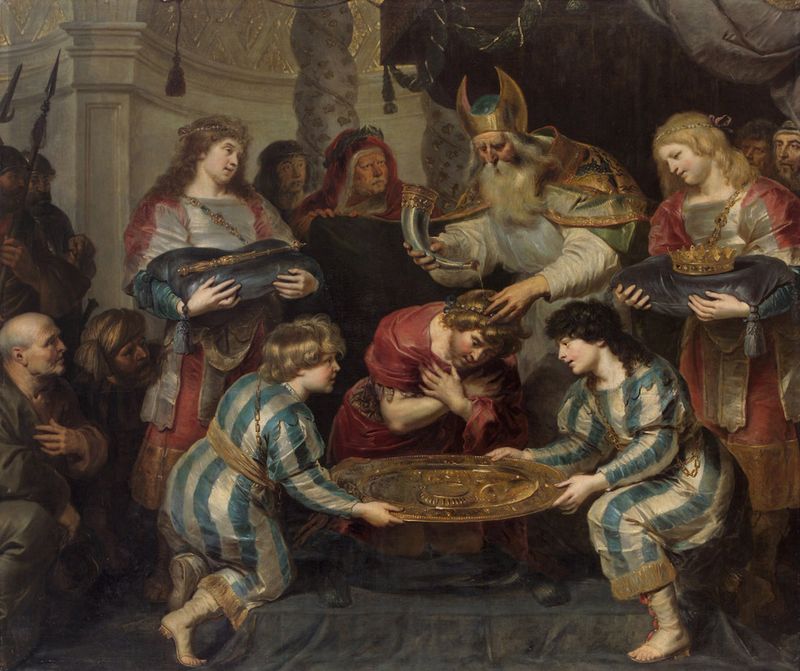
Additionally, and quite significantly, as we read 1 Kings 1, Solomon is presented as passive and reserved. He utters not one word of dialogue until he has his confrontation with his half-brother Adonijah. Solomon does not seek the king’s crown. It is all bestowed upon him providentially. His mother Bathsheba, and the prophet Nathan lay the groundwork, and then his father David, declares that he will indeed be his successor. David’s royal mount mule is provided (not a chariot), and Solomon goes down to the Gihon Spring to be anointed king, and then all Jerusalem proclaims him king as he makes his way back through the city. Solomon did not grasp for the crown.
Now, consider Absalom and Adonijah. Both sons of David, are described as beautifully handsome guys. They look the part of a king. (Just like King Saul — and we know how that worked out) And these two sons of David thought highly of themselves as well! They both grasped for the crown, and it did not end well for either one of them.
In the presentation of Solomon in this first chapter, we are reminded of the prophet Samuel being sent to Jesse to find a king to replace the tall and handsome King Saul. Each one the sons of Jesse looked the part. But none of them were “it.” “The LORD said to Samuel, ‘Do not look on his appearance or on the height of his stature, because I have rejected him. For the LORD sees not as man sees: man looks on the outward appearance, but the LORD looks on the heart’” (1 Samuel 16:7). The author of 1 Kings has this story in the back of his mind as he introduces Solomon.
When we think of the greater son of David, the Lord Jesus, he too, did not grasp for the Throne. In the beautiful hymn Paul records in Philippians 2:3-11, we see the opposite of Absalom and Adonijah, and get a sense of the ascension of King Solomon: “Do nothing from selfish ambition or conceit, but in humility count others more significant than yourselves. Let each of you look not only to his own interests, but also to the interests of others. Have this mind among yourselves, which is yours in Christ Jesus, who, though he was in the form of God, did not count equality with God a thing to be grasped, but emptied himself, by taking the form of a servant, being born in the likeness of men. And being found in human form, he humbled himself by becoming obedient to the point of death, even death on a cross. Therefore God has highly exalted him and bestowed on him the name that is above every name, so that at the name of Jesus every knee should bow, in heaven and on earth and under the earth, and every tongue confess that Jesus Christ is Lord, to the glory of God the Father.”
There is also that prophetic word from the Servant Song of Isaiah 53:1-5. The Messiah would not look like Saul, Absalom or Adonijah, but he would become the King of kings! – “Who has believed what he has heard from us? And to whom has the arm of the LORD been revealed? For he grew up before him like a young plant, and like a root out of dry ground; he had no form or majesty that we should look at him, and no beauty that we should desire him. He was despised and rejected by men; a man of sorrows, and acquainted with grief; and as one from whom men hide their faces he was despised, and we esteemed him not. Surely, he has borne our griefs and carried our sorrows; yet we esteemed him stricken, smitten by God, and afflicted. But he was pierced for our transgressions; he was crushed for our iniquities; upon him was the chastisement that brought us peace, and with his wounds we are healed.”
As you read 1 Kings 1, be aware of the contrast between these sons of David. In Solomon, catch a glimpse of the King to come. Solomon’s name is constructed from the same Hebrew consonants that form the word for “peace”: SoLoMon — ShaLoM. (There were no vowels in Hebrew originally, meaning came from context.) Solomon was indeed a king who brought peace to Jerusalem and Israel. But Solomon ultimately became Not–Solomon in the end! He was but an imperfect, flawed foretaste of what would come perfectly in Christ Jesus, The King of Peace.
Pictured: “The Anointing of Solomon” by Cornelis de Vos (1630) “The scene depicted is from the Old Testament (Kings 1, 32-39), in which at his old father David’s behest, Solomon is anointed King of Israel by Zadok the Priest. Zadok is in the act of pouring holy oil on Solomon’s head. Thus the claims to the throne of Solomon’s elder brother Adonijah were denied.”