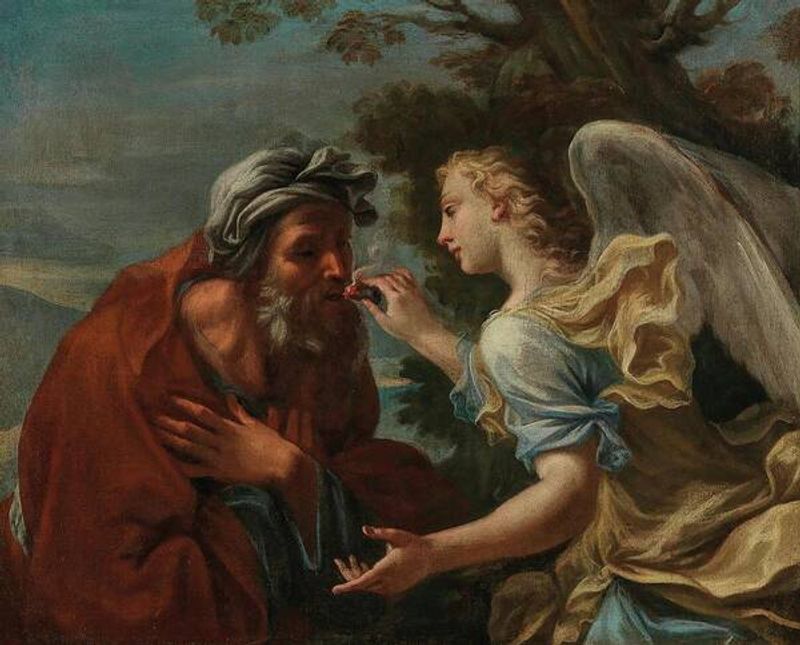
Isaiah 6:1-13
“In the year that King Uzziah died I saw the Lord sitting upon a throne, high and lifted up…”
Some ostensibly stray, but pertinent thoughts before getting to Isaiah 6…
Have you ever noticed that when someone says, “Well, the Bible clearly says…” it’s usually a doctrine, practice or belief that Christians over the millennias have never been able to find common consent? For example, who should be baptized, and how is it be administered? What’s the meaning of the Lord’s Table, and what does it even do— is it a mere memory exercise or a sacramental connection between heaven and earth? What constitutes true worship? What worship-style makes God smile? Brass tacks: expository or topical sermons? What about End Times… Dispensationalism or Covenant Theology? How about polity… How should a local church organize itself? How should churches relate to other (different) churches? Should preachers engage in partisan politics? Does God permit women to lead and preach in the Church?
“Well, the Bible clearly says…” is the omniscient on–ramp grammar often appended in response to the aforementioned questions. (Whenever I hear that retort, I always think to myself, “It is clearly not as clear as you think it is!) Now this is not to suggest the Bible isn’t perspicuous. It surely is! Channeling the Apostles’ Creed here, we can “clearly” discern the foundational truths of Scripture. The footprints of the Trinity have been noticed by most every Christian flavor for over a thousand years; most especially the singularity of the Lord Jesus Christ. Most, if not all Believers recognize human and systemic sin which necessitates the need of forgiveness and reconciliation with God. And lastly (pun intended) the anticipation of “new heavens and a new earth,” whatever the timing, saturates the Biblical imagination. These theological benchmarks, among others, constitute common ground for most Christians. Vincent of Lérins, a fifth century monk, coined a memorable aphorism to capture it: These are the things “believed everywhere, always, and by all.”
Most other hotly debated matters in and around the Bible, while of import, are not essential to saving faith, i.e. determining heaven or hell. This is so because we are always and ever growing into the Story of God’s Word. We will never exhaust Scripture. We will always be building new rooms in our minds (and hearts) for newly acquired ways of seeing. I must say, heaven is going to be much bigger than we imagine, and dare I say, populated with fellow New Jerusalemites of whom we thought theologically incorrect or something far worse during the earthly sojourn. Reality Check 101: Christians (of all stripes) have much to learn from each other to know our Bibles (and Jesus!) better. Humility is the key because convictions and understandings of Scripture and the Faith must grow and evolve and be challenged and polished throughout the pilgrimage this side of Glory. This is what the Holy Spirit works in the life of the Church.
As I look back on my own “walk” in the Faith, there have been numerable immodest times I thought I had the Bible figured out, and then the wave of A-ha!–s would flood the shoreline with a holy high tide during sermon-prep or Bible study. “I never saw this before.” “Wow, that makes sense.” “Why didn’t I see this before?” “Man! Snap, Crackle and Pop, that’ll preach!”
I share these thoughts because each week I prepare for our Bible study, there’s usually a fresh angle to the Old, Old Story I never saw coming. The well-known text from Isaiah’s “Holy, Holy, Holy” encounter in Isaiah 6 is a case in point. I have always understood this passage (Isa. 6:1-13) as a vanilla prophet commissioning. God says (6:8), “‘Whom shall I send, and who will go for us?’ Then Isaiah said, ‘Here I am! Send me.’” And so it begins. The first five chapters serve as an extended entry into the book. That’s it. Nothing to see here after the fireworks of God’s appearance. The “Here I Am, Send Me” line can then be utilized as a fund-raiser prod for missionary presentations. Cut it out, slap it on a plaque, put it on the wall. Get on with the Story.
However, if we observe more carefully Isaiah’s 8th century BC Jerusalem context, understanding of this seemingly disparate collection of oracles becomes possible, and even spiritually edifying. (A new room for new furniture.) Isaiah, as I pointed out a couple of blog entries ago, was part of the royal family (“Into Isaiah” on Oct. 23, 2026). King Uzziah was his cousin. As an observer close-up, he watched in awe as his cousin became one of the most powerful kings in Judah. His success, riches and fame spread; but eventually (predictably) became the source of rot to the core. More than mere introduction, the first five chapters of Isaiah become a prophetic, pensive arrow of divine critique of Uzziah, his court, and the complicity of the people. Isaiah 5 culminates in a prophetic parable of “a vineyard” planted by God, carefully and lovingly. The vineyard, of course, represents king and country. Yet despite all the divine TLC, the grape harvest was sour. How could that be?
This brings us into chapter 6. “In the year that King Uzziah died I saw the Lord sitting upon a throne, high and lifted up; and the train of his robe filled the temple.” Many believe this vision occurred in the year 738 BC, which happened to be the time frame when a devastating earthquake rocked the Holy Land. Two other prophets, Amos (1:1) and Zachariah (14:5) make mention of this quake. In Judaism, exposition of Isaiah 6 insists that this quake providentially coincided with the beginnings of the Assyrian invasion from the north, as well as the day Uzziah was struck with leprosy. The rattling of the earth was, they surmise, a divine rebuke to a good king gone bad. Uzziah sealed his demise by usurping the priestly prerogative of offering sacrifices in the Temple (2 Chron. 26:1-23). Thereby, “In the year that King Uzziah died…” becomes the moment, for all practical purposes and intent, the king “died” by becoming a social pariah.
Isaiah is in the Temple when the quake hits and the vision of God, high and lifted up, descends: “Holy, Holy, Holy is the LORD of hosts; the whole earth is full of his glory! And the foundations of the thresholds shook [quaked!] at the voice of him who called, and the house was filled with smoke.”
To summarize from there, God commissions his prophet to pronounce judgment on Israel and Judah (6:9-10): “Go and say to this people: Keep on hearing, but do not understand; keep on seeing, but do not perceive. Make the heart of this people dull, and their ears heavy, and blind their eyes; lest they see with their eyes, and hear with their ears, and understand with their hearts, and turn and be healed.” In other words, “Enough!” says God. “I’m coming in judgment. If you are wise, you will see and hear this and come back to me; but you are thick, and I know you won’t.” Outside of a miraculous intervention from God, people will not (cannot) save themselves.
Isaiah, waxing Abrahamic in the run up to the destruction of Sodom and Gomorrah (Gen. 18:16-33), pleads mercy for his people (6:11): “How long, O Lord?” That is, “How long must I give voice to this painful word?” God responds that exile will come. Destruction will come. Nevertheless, though the city burns and the surrounding area is devastated, “a stump” shall remain. (6:13) “The holy seed is its stump” (Think Jesus language here— Isaiah 11:1-5 and Matthew 2:23). Even as faithlessness and waywardness reigns in Israel and Judah, God will make a way to restore and reconcile his people. But a way will also be made for many more people— We know the way the Story plays out in the New Testament.
There is another foretaste of Gospel-dom earlier in this “Holy, Holy, Holy” pericope. When the prophet is commissioned with voicing judgment, he says, “Woe is me! For I am lost; for I am a man of unclean lips, and I dwell in the midst of a people of unclean lips; for my eyes have seen the King, the LORD of hosts!” Nevertheless, in a non-sequitur moment from God, there is this incredible, unilateral, purifying, gracious move from the LORD: (6:6-7) “One of the seraphim flew to me, having in his hand a burning coal that he had taken with tongs from the altar. And he touched my mouth and said: ‘Behold, this has touched your lips; your guilt is taken away, and your sin atoned for.’” Already, a preview of what God will do through the holy seed of the stump. “Behold, the Lamb of God, who takes away the sin of the world!” (John 1:29)
My understanding of the Book of Isaiah is coming into clearer, Christological focus. This is why this book is quoted liberally in the New Testament. It is in these Aha moments that I find encouragement to keep digging, reading and studying. Never being content to let the waters of contemplation and examination stagnate.
Stay curious, people.