
Isaiah 7:1-25
“Behold, the virgin shall conceive and bear a son, and shall call his name Immanuel.”
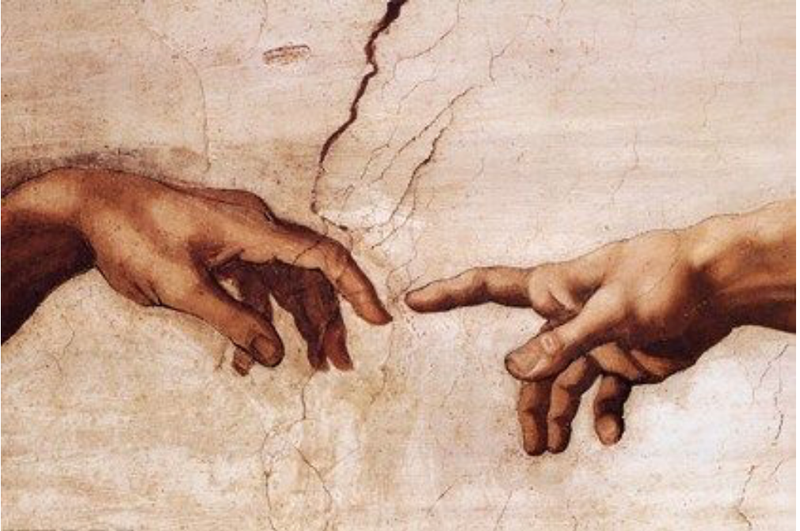
The art shared in this blog entry is a cameo perspective of one of the world’s most recognizable fresco works. It is Michelangelo’s “The Creation of Adam.” It was painted on the ceiling of the Sistine Chapel in the 16th century. The scene depicts God upon a cloud accompanied by the heavenly host, stretching out his finger towards Adam to impart life. Observe that the finger of God on the right is straight and sure, while Adam’s finger, on the left, is lazily indifferent— a creative portending of the immanent Fall that will define human life east of Eden.
Adam’s lethargic response to God at "The Creation" is re-lived in Isaiah 7 with King Ahaz. This Ahaz of ill-repute, the Talmud reveals that his full name was Jehoahaz, the “Jeho” referencing the name of God; yet the author of the Book of Kings removed the Dei-atific prefix from his name.
Here's the way it goes down: Around the year 735–732 BC, Isaiah met with King Ahaz “…at the end of the conduit of the upper pool on the highway to the Washer's Field” (a location that will be referenced again in Isa. 36:2 in a similar such crisis, with a quite different kind of king). There was fear and loathing throughout the Holy Land, from Damascus all the way down to Egypt. Tiglath-pileser of the fearsome Assyrian Empire was beginning to cast an ominous shadow over the Levant.
Pekah, the king of the northern kingdom of Israel (also referred to as Ephraim) and Rezin, the king in Damascus, conspired together to invade Jerusalem, and to force Ahaz and the southern kingdom of Judah to join their alliance against big, bad Assyria (cf. 2 Kings 16:5). Imagine the consternation in the head of Ahaz in those days: Trouble queuing up to the north like fighter jets on the tarmac, waiting for the cue to bomb Jerusalem. This is the context of Isaiah 7.
Subsequently, Isaiah meets the king "at the end of the conduit of the upper pool on the highway to the Washer's Field." To rehearse the scene in a short and tidy account, Isaiah, along with his son, Shear-jashub (the name prophetically meaning “A remnant shall return,” signaling potential exile apart from faith), declares (7:4), “Be careful, be quiet, do not fear, and do not let your heart be faint because of these two smoldering stumps of firebrands, at the fierce anger of Rezin… and the son of Remaliah [i.e. King Pekah].” “Smoldering stumps” to be extinguished! In other words, insignificant twits.
Isaiah reminds Ahaz of his God. Almighty God. His Rock and Defender. He says don’t do the alliance. Don’t trust in human alliances, for only the Lord your God is able to deliver Jerusalem. Believe! Then the prophet utters the words that becomes the favorite memory verse of young Bible students everywhere: “If you do not stand firm in your faith [Ahaz], you will not stand at all” (7:9 NIV).
(7:11) “Ahaz, the Lord bids you; …no, commands you, implores you, to ask for a sign to substantiate this incredible promise.” Normally, asking for signs are thought to be Gideon-esque milquetoast. But in this particular, historic moment, God is inviting “the ask” for confirmation. But limp-fingered Ahaz feigns faith in his faithlessness. “I will not ask, and I will not put the LORD to the test” (7:12). The upshot: Ahaz has no faith in God. Ahaz will have faith in the king of Assyria, Tiglath-pileser, and Tiglath-pileser’s gods lining the temple in Damascus (cf. 2 Kings 16:10-18).
One of the saddest reads in the Story of God’s people comes in these words: “Ahaz sent messengers to Tiglath-pileser king of Assyria, saying, ‘I am your servant and your son. Come up and rescue me from the hand of the king of Syria and from the hand of the king of Israel, who are attacking me.’ Ahaz also took the silver and gold that was found in the house of the LORD and in the treasures of the king's house and sent a present to the king of Assyria. And the king of Assyria listened to him.”
This rejection of God is what brings the well-known Virgin Birth prophecy from Isaiah (7:14-17):
“Therefore the Lord himself will give you a sign.
Behold, the virgin shall conceive and bear a son, and shall call his name Immanuel.
He shall eat curds and honey when he knows how to refuse the evil and choose the good.
For before the boy knows how to refuse the evil and choose the good,
the land whose two kings you dread will be deserted.
The LORD will bring upon you and upon your people and upon your father's house
such days as have not come since the day that Ephraim departed from Judah—
the king of Assyria.”
The sign of Immanuel means “God with Us.” Isaiah tells Ahaz that if you would have stood in faith, God would have been with you! But since not, the two kings you fear, Pekah and Rezin, will be destroyed and off the scene before a new-born child is old enough to say, “goo-goo, gah-gah.” A short time! And. The king you really dread, the one you foolishly believe will deliver you, will come against you in great ferocity.
The sign of Immanuel in Isaiah does not refer to a virgin birth as we think of The Virgin Birth in Jesus. Here, it is likely a child that will be born in the prophet, or the king’s household. The message is that God would have been the strong arm of protection. But faithless Ahaz rejects God.
That prophecy is fulfilled in short order: Pekah and Rezin are disposed of quickly by Assyria, the northern kingdom of Israel subsequently being scattered in Exile in 722 BC, and mighty Sennacherib of Assyria, coming for Ahaz’s son, King Hezekiah and besieging Jerusalem (2 Kings 18-19).
God could have been with them!
Fast forward now to the Gospel of Matthew, and the sole reference to the Immanuel prophecy of Isaiah in Matthew 1:18-25. The angel of the Lord appears before Joseph in a dream, “Joseph, son of David, do not fear to take Mary as your wife, for that which is conceived in her is from the Holy Spirit. She will bear a son, and you shall call his name Jesus, for he will save his people from their sins.”
Now Joseph could have been Ahaz-like, and responded, “Yes, of course. Sure. That sounds like a plan to me…” And then, walked out of the room and divorced the loose woman. But we’re not talking about Ahaz here. “Being a just man… when Joseph woke from sleep, he did as the angel of the Lord commanded him: he took his wife, but knew her not until she had given birth to a son. And he called his name Jesus (1:19, 24-25).”
This, we are told by Matthew (1:22-23), “All this took place to fulfill what the Lord had spoken by the prophet: ‘Behold, the virgin shall conceive and bear a son, and they shall call his name Immanuel’ (which means, God with us).”
A faithful son of David— unlike another son of David named Ahaz— Joseph believes.
And as a matter of course, Christ Jesus, “God with Us,” comes into the world.
And, we know the rest of the Story.
O come, O come, Emmanuel,
And ransom captive Israel,
That mourns in lonely exile here
Until the Son of God appear.
Rejoice! Rejoice! Emmanuel
shall come to thee, O Israel.
